
 中文
中文 English
CXSD62102A单相定时同步的PWM控制器驱动N通道mosfet功率因数调制(PFM)或脉宽调制(PWM)模式下都能瞬态响应和准确的直流电压输出
目录
1.产品概述 2.产品特点
3.应用范围 4.下载产品资料PDF文档
5.产品封装图 6.电路原理图
7.功能概述 8.相关产品
一,产品概述(General Description)
The CXSD62102A is a single-phase, constant on-time,synchronous PWM controller, which drives N-channel MOSFETs. The CXSD62102A steps down high voltage to generate low-voltage chipset or RAM supplies in notebook computers.
The CXSD62102A provides excellent transient response and accurate DC voltage output in either PFM or PWM Mode.In Pulse Frequency Mode (PFM), the CXSD62102A provides very high efficiency over light to heavy loads with loading-
modulated switching frequencies. In PWM Mode, the converter works nearly at constant frequency for low-noise requirements.
The CXSD62102A is equipped with accurate positive current limit, output under-voltage, and output over-voltage protections, perfect for NB applications. The Power-On-Reset function monitors the voltage on VCC to prevent wrong operation during power-on. The CXSD62102A has a 1ms digital soft start and built-in an integrated output discharge device for soft stop. An internal integrated soft-
start ramps up the output voltage with programmable slew rate to reduce the start-up current. A soft-stop function actively discharges the output capacitors.
The CXSD62102A is available in 16pin TQFN3x3-16 package respectively.
二.产品特点(Features)
Adjustable Output Voltage from +0.6V to +3.3V
- 0.6V Reference Voltage
- ±0.6% Accuracy Over-Temperature
Operates from An Input Battery Voltage Range of
+1.8V to +28V
REFIN Function for Over-clocking Purpose from
0.5V~2.5V range
Power-On-Reset Monitoring on VCC pin
Excellent line and load transient responses
PFM mode for increased light load efficiency
Programmable PWM Frequency from 100kHz to 500kHz
Built in 30A Output current driving capability
Integrate MOSFET Drivers
Integrated Bootstrap Forward P-CH MOSFET
Power Good Monitoring
70% Under-Voltage Protection
125% Over-Voltage Protection
TQFN3x3-16 Package
Lead Free and Green Devices Available (RoHS Compliant)
三,应用范围 (Applications)
Notebook
Table PC
Hand-Held Portable
AIO PC
四.下载产品资料PDF文档
需要详细的PDF规格书请扫一扫微信联系我们,还可以获得免费样品以及技术支持!

五,产品封装图 (Package)

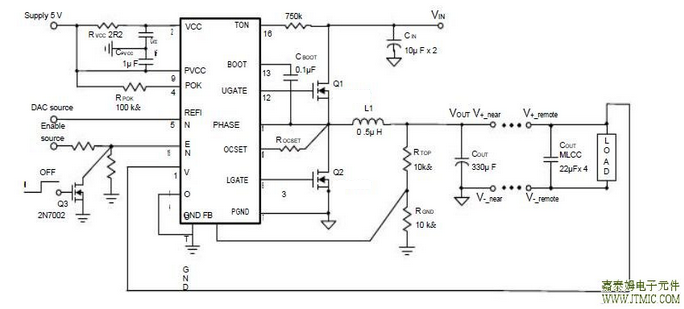
六.电路原理图
七,功能概述
Input Capacitor Selection (Cont.)
higher than the maximum input voltage. The maximum RMS current rating requirement is approximately IOUT/2,
where IOUT is the load current. During power-up, the input capacitors have to handle great amount of surge current.
For low-duty notebook appliactions, ceramic capacitor is recommended. The capacitors must be connected be-
tween the drain of high-side MOSFET and the source of low-side MOSFET with very low-impeadance PCB layout.
MOSFET Selection
The application for a notebook battery with a maximum voltage of 24V, at least a minimum 30V MOSFETs should
be used. The design has to trade off the gate charge with the RDS(ON) of the MOSFET:
For the low-side MOSFET, before it is turned on, the body diode has been conducting. The low-side MOSFET driver
will not charge the miller capacitor of this MOSFET.In the turning off process of the low-side MOSFET, the
load current will shift to the body diode first. The high dv/dt of the phase node voltage will charge the miller capaci-
tor through the low-side MOSFET driver sinking current path. This results in much less switching loss of the low-
side MOSFETs. The duty cycle is often very small in high battery voltage applications, and the low-side MOSFET
will conduct most of the switching cycle; therefore, when using smaller RDS(ON) of the low-side MOSFET, the con-
verter can reduce power loss. The gate charge for this MOSFET is usually the secondary consideration. The
high-side MOSFET does not have this zero voltage switch-ing condition; in addition, it conducts for less time com-
pared to the low-side MOSFET, so the switching loss tends to be dominant. Priority should be given to the
MOSFETs with less gate charge, so that both the gate driver loss and switching loss will be minimized.
The selection of the N-channel power MOSFETs are determined by the R DS(ON), reversing transfer capaci-
tance (CRSS) and maximum output current requirement.The losses in the MOSFETs have two components:
conduction loss and transition loss. For the high-side and low-side MOSFETs, the losses are approximately
given by the following equations:
Phigh-side = IOUT (1+ TC)(RDS(ON))D + (0.5)( IOUT)(VIN)( tSW)FSW
Plow-side = IOUT (1+ TC)(RDS(ON))(1-D)
Where TC is the temperature dependency of RDS(ON)FSW is the switching frequency
tSW is the switching interval D is the duty cycle Note that both MOSFETs have conduction losses while
the high-side MOSFET includes an additional transition loss. The switching interval, tSW, is the function of the reverse transfer capacitance CRSS. The (1+TC) term is a factor in the temperature dependency of the RDS(ON) and can be extracted from the “RDS(ON) vs. Temperature” curve of the power MOSFET.
Layout Consideration
In any high switching frequency converter, a correct layout is important to ensure proper operation of the regulator.
With power devices switching at higher frequency, the resulting current transient will cause voltage spike across
the interconnecting impedance and parasitic circuit elements. As an example, consider the turn-off transition
of the PWM MOSFET. Before turn-off condition, the MOSFET is carrying the full load current. During turn-off,
current stops flowing in the MOSFET and is freewheeling by the low side MOSFET and parasitic diode. Any parasitic
inductance of the circuit generates a large voltage spike during the switching interval. In general, using short and
wide printed circuit traces should minimize interconnect- ing impedances and the magnitude of voltage spike.
Besides, signal and power grounds are to be kept sepa- rating and finally combined using ground plane construc-
tion or single point grounding. The best tie-point between the signal ground and the power ground is at the nega-
tive side of the output capacitor on each channel, where there is less noise. Noisy traces beneath the IC are not
recommended. Below is a checklist for your layout:· Keep the switching nodes (UGATE, LGATE, BOOT,
and PHASE) away from sensitive small signal nodes since these nodes are fast moving signals.
Therefore, keep traces to these nodes as short as
side MOSFET. On the other hand, the PGND trace should be a separate trace and independently go to
the source of the low-side MOSFET. Besides, the cur-rent sense resistor should be close to OCSET pin to
avoid parasitic capacitor effect and noise coupling.
· Decoupling capacitors, the resistor-divider, and boot capacitor should be close to their pins. (For example,
place the decoupling ceramic capacitor close to the drain of the high-side MOSFET as close as possible.)
· The input bulk capacitors should be close to the drain of the high-side MOSFET, and the output bulk capaci-
tors should be close to the loads. The input capaci-tor’s ground should be close to the grounds of the
output capacitors and low-side MOSFET.
· Locate the resistor-divider close to the FB pin to mini-mize the high impedance trace. In addition, FB pin
traces can’t be close to the switching signal traces (UGATE, LGATE, BOOT, and PHASE).
Layout Consideration (Cont.)
possible and there should be no other weak signal traces in parallel with theses traces on any layer.
· The signals going through theses traces have both high dv/dt and high di/dt with high peak charging and
discharging current. The traces from the gate drivers to the MOSFETs (UGATE and LGATE) should be short
and wide.
· Place the source of the high-side MOSFET and the drain of the low-side MOSFET as close as possible.
Minimizing the impedance with wide layout plane be-tween the two pads reduces the voltage bounce of
the drain of the MOSFETs (VIN and PHASE nodes) can get better heat sinking.
· The PGND is the current sensing circuit reference ground and also the power ground of the LGATE low-
-
CXSD62102ACXSD62102A
八,相关产品 更多同类产品......
|
Switching Regulator > Buck Controller |
||||||||||
|
Part_No |
Package |
Archi tectu |
Phase |
No.of PWM Output |
Output Current (A) |
Input Voltage (V) |
Reference Voltage (V) |
Bias Voltage (V) |
Quiescent Current (uA) |
|
|
min |
max |
|||||||||
|
SOP-14 QSOP-16 QFN4x4-16 |
VM |
1 |
1 |
30 |
2.9 |
13.2 |
0.9 |
12 |
8000 |
|
|
SOP-8 |
VM |
1 |
1 |
20 |
2.9 |
13.2 |
0.8 |
12 |
5000 |
|
|
SOP-8 |
VM |
1 |
1 |
20 |
2.9 |
13.2 |
0.8 |
12 |
5000 |
|
|
QFN4x4-24 |
VM |
2 |
1 |
60 |
3.1 |
13.2 |
0.6 |
12 |
5000 |
|
|
SOP-8 |
VM |
1 |
1 |
20 |
2.2 |
13.2 |
0.8 |
5~12 |
2100 |
|
|
SOP-8 |
VM |
1 |
1 |
20 |
2.2 |
13.2 |
0.8 |
5~12 |
2100 |
|
|
SOP8|TSSOP8 |
VM |
1 |
1 |
5 |
5 |
13.2 |
1.25|0.8 |
5~12 |
3000 |
|
|
SOP-8 |
VM |
1 |
1 |
10 |
3.3 |
5.5 |
0.8 |
5 |
2100 |
|
|
SOP-14 |
VM |
1 |
1 |
10 |
5 |
13.2 |
0.8 |
12 |
2000 |
|
|
TSSOP-24 |QFN5x5-32 |
VM |
1 |
2 |
20 |
5 |
13.2 |
0.6 |
5~12 |
4000 |
|
|
SOP14 QSOP16 QFN-16 |
VM |
1 |
1 |
30 |
2.9 |
13.2 |
0.9 |
12 |
4000 |
|
|
SOP-14 |
VM |
1 |
1 |
30 |
2.2 |
13.2 |
0.6 |
12 |
5000 |
|
|
SOP-14 |
VM |
1 |
1 |
30 |
2.2 |
13.2 |
0.6 |
12 |
5000 |
|
|
SOP-14 |
VM |
1 |
1 |
25 |
2.2 |
13.2 |
0.8 |
12 |
5000 |
|
|
LQFP7x7 48 TQFN7x7-48 |
VM |
1 |
6 |
0.015 |
1.4 |
6.5 |
- |
5 |
1800 |
|
|
TSSOP-24P |
VM |
1 |
2 |
20 |
2.97 |
5.5 |
0.8 |
5~12 |
5000 |
|
|
|
||||||||||


发表评论